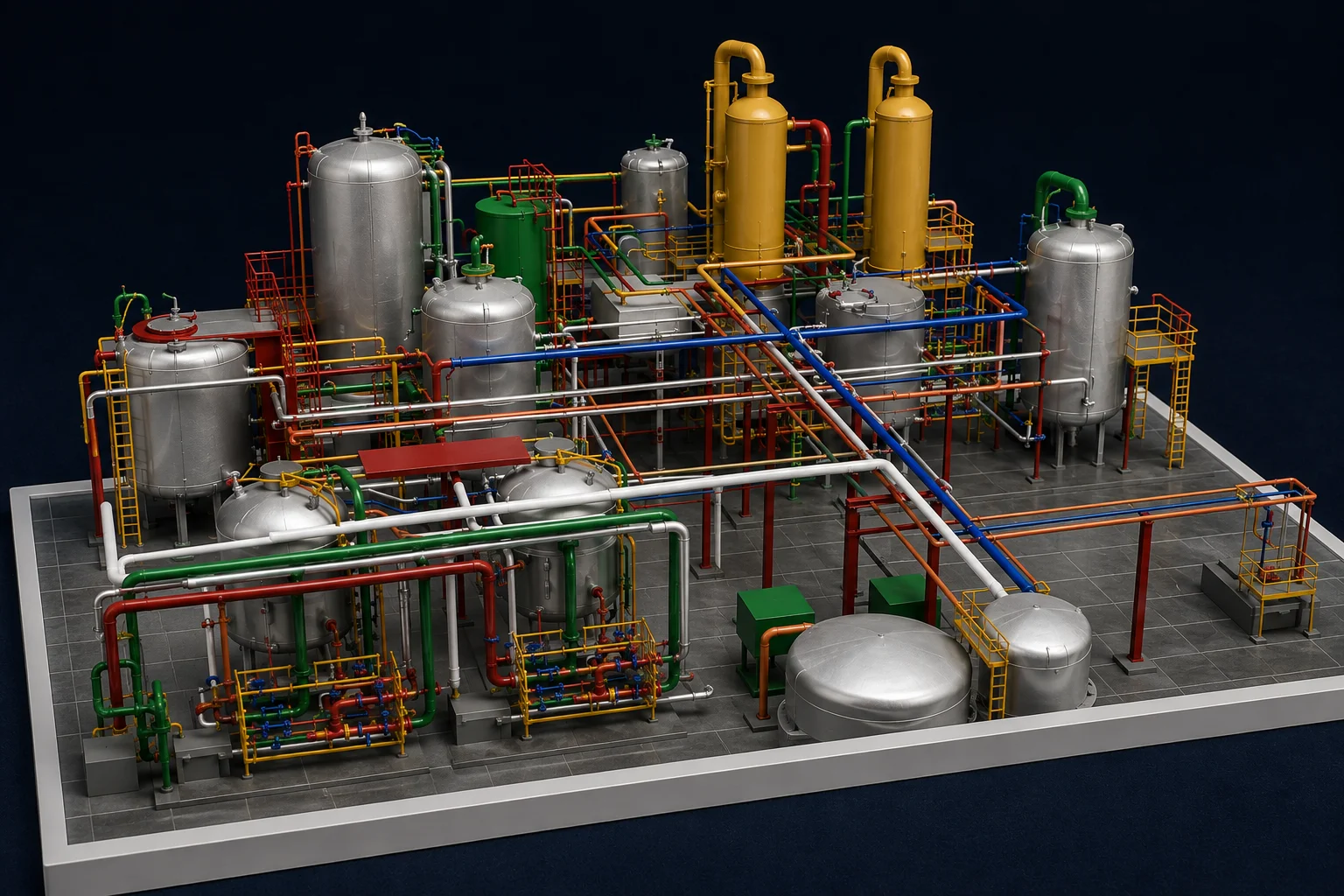
Most operators remember their first week in a plant. Everything looks the same. Pipes overhead, valves at every turn, tags in a system nobody has explained yet. A senior colleague says, “Isolate the line before the pump,” and you nod, hoping you’ll spot the right valve when the time comes. It’s a stressful way to learn, and in a process environment, it can be a risky one.
This is where a plant piping system model earns its place. Instead of learning the geography of a plant only by walking through it, people can study it first in a scaled, safe, hands-off form. This article explains how these models are used for training and planning, and what makes some far more useful than others.
The problem with learning on the job
Real plants are big, noisy, hot and busy. Trainers can’t stop production to give a leisurely tour, and trainees can’t wander freely around live equipment. Lessons happen in bursts, between other tasks, and a lot of information gets lost.
Drawings help, but process and instrumentation diagrams are drawn for engineers. They show how things connect, not how they’re arranged in physical space. A trainee can understand the diagram and still not know where the valve actually sits, or how to reach it. A physical layout fills that gap by connecting the logic of a flow diagram to the layout of the site.
What a training-oriented model looks like
Unlike a pure presentation piece, a training model puts clarity first. Lines are colour-coded by service. Main valves, isolation points, drain points and emergency shutdown devices are marked and numbered. Equipment carries tags matching the plant labels, so trainees learn the names they’ll use every day.
Scale is chosen so that hands can reach and eyes can read. Many models sit at scales like 1:25 or 1:50 for a single unit, since these allow accurate valve types and clear labels. Bases are designed with enough space around the edge for a group of trainees to gather.
Some models add extra features. Removable sections let instructors show what’s beneath a platform or inside a compact area. Lighting can highlight a chosen route, for example, the path a fluid takes from a storage tank through a pump and a heat exchanger to a reactor. It turns a static object into a teaching tool.
Practical ways teams use it
Induction is the most common. New joiners get a tour of the model on day one, before they see the site. They learn where units are, how they connect, and what the main flow paths look like. When they walk into the real plant later, it feels familiar.
Isolation and lockout practice is another. Trainers can ask, “If we need to work on this pump, which valves do we close and in what order?” Trainees point to answers on the model and discuss them before anyone touches a real handwheel. Mistakes cost nothing, and the discussion sticks.
Emergency drills benefit as well. Teams can talk through what to do if a leak occurs at a specific location, which lines to isolate, where to evacuate and where the fire water is. Because everyone can see the same layout, disagreements about routes are settled quickly.
Shutdown and maintenance planning also makes good use of it. Planners and contractors can discuss scaffolding, lifting routes and work sequences on the replica, which reduces surprises on the day.
What a typical session looks like
A good session doesn’t need to be elaborate. Picture six new operators gathered around the model with a trainer and a laminated flow diagram. The trainer picks a storage tank and asks the group to trace the line to the nearest pump. Two people point in different directions, which starts a useful discussion. They compare the routes on the model, check the tags against the diagram, and agree on the correct path. Ten minutes later they’ve covered ground that might take a full morning of wandering the real site. Short, focused exercises like this, repeated over a few weeks, build confidence far faster than a single long lecture ever could.
Colleges and technical institutes
It’s not just industry. Engineering colleges and technical training institutes use these models to teach students how real plants are organised. Textbooks are full of flow diagrams, but many students graduate without seeing how a full-scale pipe network is laid out. A model helps them understand ideas like pipe racks, expansion loops, pump suction arrangements and access for maintenance.
Instructors say the reaction is often immediate. Students who struggled with abstract diagrams start asking practical questions once there’s something in front of them. “Why is the pump lower than the tank?” “Why is there a drain at this low point?” Those are exactly the questions a good engineer learns to ask.
Making a model that works as a teaching aid
Start with the learning objectives. What should someone be able to do after using it? Find a valve? Trace a line? Understand a start-up sequence? The answers determine what to show and how to label it.
Keep it readable. A model overloaded with fine detail can be more confusing than helpful. Focus on the main routes, key valves and safety-critical equipment, and let the smaller items support rather than compete.
Build it sturdy. Training models are handled and leaned on. Strong joints, protected edges and a durable finish make a real difference, especially in environments with frequent group use.
Plan for change. Plants are modified over time, and an outdated training model is worse than none, because it teaches people the wrong layout. Ask whether sections can be replaced or updated as the plant evolves, and who will be responsible for making those changes when the time comes.
Where to look for help
If you’re considering one for a training centre or control room, it’s worth speaking with makers who have experience turning plant drawings into practical learning tools. Looking at a finished plant piping system model in person, or at least through detailed photographs, will show you how labelling, colour coding and construction quality work together in real use.
Final thoughts
Good training turns unfamiliar places into familiar ones before anything goes wrong. A carefully planned plant piping system model does exactly that. It gives new operators a head start, helps experienced teams rehearse tough jobs, and turns abstract diagrams into something you can point at. In a workplace where clarity matters, that’s a practical advantage that’s hard to match.